Do You Know Where Your Food Came From?


Today, there are two different ways of farming – industrial and sustainable.  Industrial agriculture is the modern way of farming when factories mass produce food.  Sustainable farming is when farmers use the traditional way of farming using environmentally, economically, and morally correct methods to produce healthy food.

Most of the foods we find in our local grocery store are made from industrial agriculture.  Are they actually healthy, cheap and the solution to world hunger?

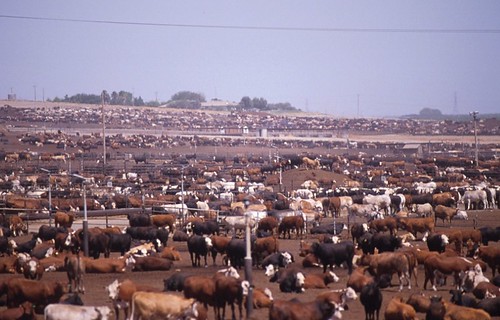
Cows in industrial farms.
Industrial agriculture uses chemicals to mass produce food.  The pesticides used in industrial farming would leak into the soil, which eventually leak into the ground water and lakes, poisoning the water.  When an animal gets sick, they are injected with antibiotics.  When we eat the animals, we are more resistant to antibiotics, making medicine less effective.  In order to mass produce food, they inject animals with hormones to quicken their growth process (see right). 

Cows in sustainable farms.
In sustainable agriculture, however, they try to prevent the use of pesticides by using biological control and pest-resistant plants to control unwanted pests.  Instead of using antibiotics, sick animals are pulled away from the herd.  Animals are treated with respect; they carry out their natural behaviours and hormones are not used (see right).

Most people believe that food made from industrial agriculture is cheaper than food made on sustainable farms.  For example, organic bananas cost around $0.79/lb while non-organic bananas cost around $0.69/lb.  At first glance, non-organic food may seem cheaper, but once you factor in the price for treatments and risks in health, it is much more expensive. 

Does industrial agriculture provide more diverse choices?  No it doesn’t.  Industrial farming uses a technique called monoculture crop system, where they only produce one type of crop.  Sustainable agriculture uses different techniques which would preserve biodiversity.

The most misbelieved fact about industrial agriculture is that it would help save the world from hunger due to the mass production of food.  However, this isn't true.  Poverty is usually not due to lack of food but not being able to get access to food.  Industrial agriculture increases the chance of poverty.  It increases the general cost of farming, so it is now harder for farmers to produce food on their own to support their community.  The lack of farmers would lead to lack of food production.  This is then compensated by using industrial agriculture to mass produce food.

I think that the benefits of industrial agriculture do not outweigh the risks.  It’s like saying that it’s better to eat food that could potentially kill you than to spend more money for a not only a healthier but a more ethnical choice.  I think that the largest problem is not convenience and price but the lack of information and knowledge to the consumers.  If people were well educated about the dangers of industrial agriculture, I think that they would choose sustainable agriculture over industrial (watch video to see more ‘myths’ about industrial agriculture).


Child educating adults about industrial farming.


RESOURCES:

PICTURE RESOURCES:

VIDEO RESOURCE:

COMMENTS:

Lets Design A Baby!


Steps to create a healthy baby through PGD
The term 'designer baby' is given to babies that are genetically modified through a process called Pre-Implantation Genetic Diagnosis (PGD).  During this process, a three day old embryo (containing around six cells) is tested for genetic diseases.  When the embryo is declared healthy, it gets implanted in the mother’s womb.  The embryo was created through a process called In Vitro Fertilization (IVF).  In this method, the egg and sperm are fertilized outside the body instead of inside the mother’s womb. This method was originally used to prevent hereditary diseases such as blindness.

For example, Chris and Tanya Kirby wanted to have children. However, they were worried that the child  would inherit a heart disease that Chris had.  They decided to turn to artificial insemination to ensure that their future children were healthy (see right).  Due to their choice they successfully welcomed healthy twins to their family. 

As the treatment became more popular, future parents were seeking for a way to alter the physical appearance of their offspring (see steps below).  Others may want to create a ‘saviour baby’ – a child designed to with healthy and compatible cells to save an older sibling from an illness.  In these situations, they use a small chip coated with DNA called a microarray.  The chip allows one to analyze single nucleotide polymorphisms (SNPs) to predict different traits of the baby such as hair and eye colour.

[designer baby]
Steps of In Vitro Fertilization to alter physical appearance of baby
Because it uses relatively new technology, it is quite expensive.  The Kirbys had to pay almost thirty thousand dollars to ensure that their child is healthy.  The treatment is not always successful either; Canada’s average success rate is about 20%.  Women under 40 have a greater (one in four) chance than older women (one in ten) for success.  These, unfortunately, are not the only consequences that the parents have to pay.  Once their child finds out about it, who knows how they would react. 

This idea may seem very appealing at first, but problems regarding ethical issues arise.  

Most parents would want their child to be born healthy. I don’t think that there is anything ethically wrong about using this technology to ensure that.  However, I think it is taking a step too far to use this technology to change a baby’s feature or to create a baby to heal another child.  I don't think parental love would be affected by the physical appearance or the health of the child - they would (at least they should) love their child no matter what.  Developing a child to heal another child is basically using them as a tool.  The baby is a human being.  We are too.  Sometimes, we become too greedy in striving for the better when things are fine they way they were.  On this issue, I believe that it’s better to not let science interfere with nature’s way.


RESOURCES:


PICTURE RESOURCES:

Mark May 22 on Your Calendar!


Biodiversity is important for life on earth; it is the variety of life on earth. It sustains life and create insurance for the future. Humans have the power to either destroy or protect diversity on earth. What humans have done to harm the earth is irreversible, but we can prevent it from happening.

These four statements, taken from the International Year of Biodiversity site, explain how biodiversity is important to us and how WE can make a difference. This year, 2010, is the International Year of Biodiversity (logo is shown to the right).
The logo of Year of Biological
Diversity

On top of that, the United Nations declared May 22 to be the International Day for Biological Diversity (also known as IDB). On this day, countries around the world take part in bringing awareness of the importance of biodiversity and how every individual can help to sustain it.

Every year, they develop a theme to focus on.  This year, it was dedicated to development and poverty alleviation (a poster shown at the bottom left).

It was announced that the biodiversity target for 2010 was:


"to achieve... a significant reduction of the current rate of biodiversity loss at the global, regional and national level as a contribution to poverty alleviation and to the benefit of all life on earth."

How does development and poverty relate to biodiversity? 

A poster for this year's IDB
They might relate more than you think.  The general definition of development is that all people have the opportunity to live a good life.  Poverty is when people are unable to meet those needs.  More than 3 billion people rely on marine biodiversity and 1.6 billion people rely on forests and fruits grown from those plants.  That being said, biodiversity is the key that reduces poverty; it provides people with basic necessities (such as food and medicine) and services (such as climate control and purification).

Countries around the world including Canada have stepped up to do something about sustaining the biodiversity of earth.  In Ontario, we hosted a forum in Serpent River Basin (map shown below) to raise awareness and protect biodiversity during mineral exploration.  An ‘eco-fair’ was held where organizations displayed information about this issue in various stands.  The objective of this event on IDB was to explore mineral practices and their impact to meet the expectations of the public for biodiversity.

The approximate location of Serpent River
Biodiversity plays an important part in humanity.  It does not only include extinction of animals; it directly affects our everyday needs such as food.  I think that IDB is an important day to create awareness to the world about how our daily activities affect biodiversity, which can later affect us.  I think that it is great that this day is international, being held in different parts of the world.  This shows that humans DO care about the environment and can work together to create a positive impact on the diversity of our ecosystems. 

RESOURCES:
http://www.cbd.int/idb/